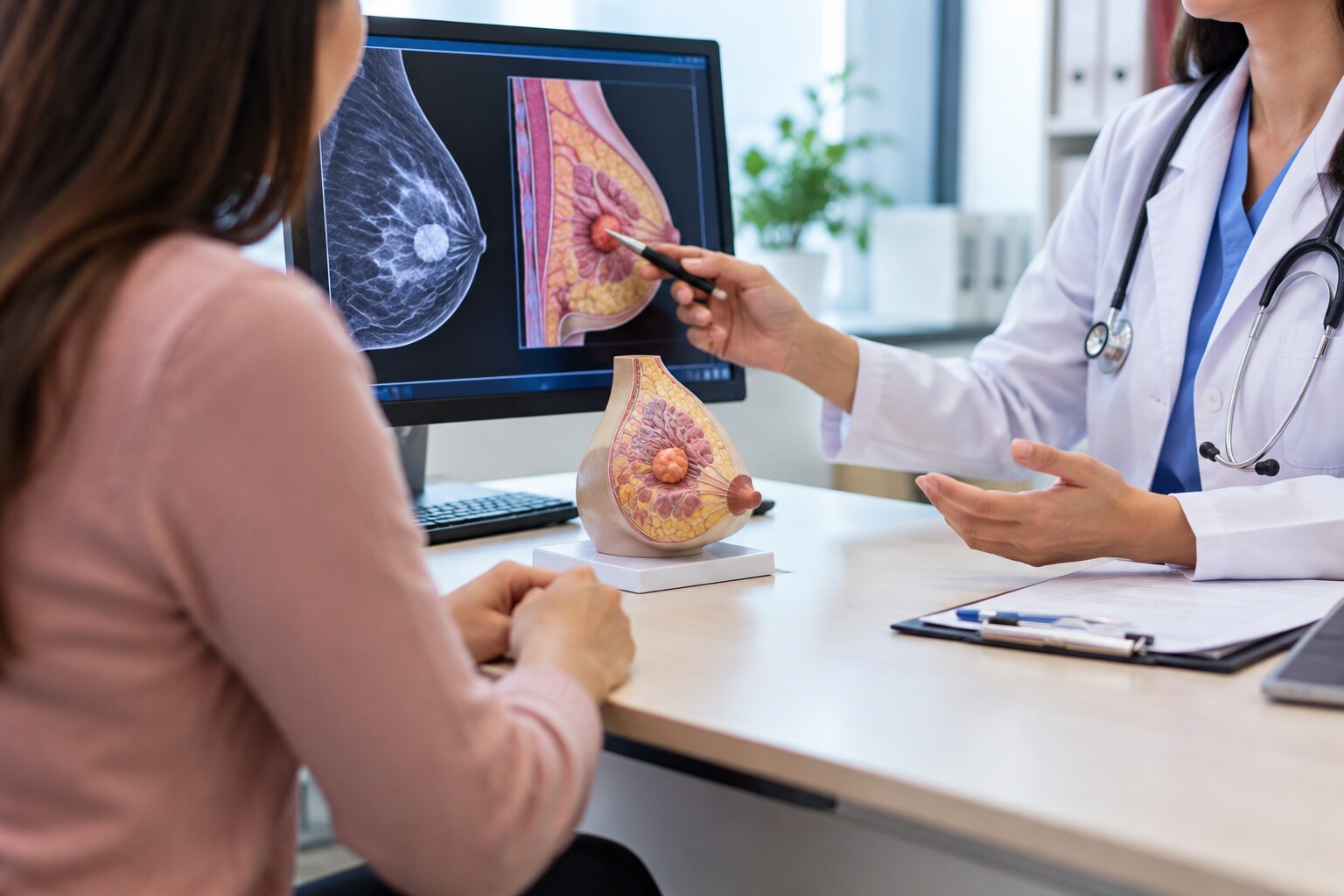
The right operation depends on more than the presence of a breast tumour: pathology, imaging, tumour distribution, lymph-node findings, inherited risk, planned drug treatment, and whether you can receive radiotherapy all affect the decision. By the end, you will know what each operation involves, which questions distinguish lumpectomy from mastectomy, and how pathology and reconstruction decisions shape treatment after surgery.
Key takeaways
- Choose lumpectomy when the tumour can be removed with clear margins.
- Lumpectomy usually requires radiotherapy; mastectomy does not always avoid it.
- Ask how lymph-node results could change surgery, medicines and radiotherapy.
- Discuss reconstruction timing before surgery if radiotherapy may be needed.
Which breast operation fits the cancer?
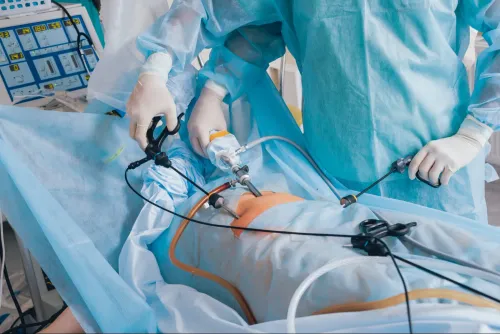
The right operation depends on whether cancer is invasive, confined to ducts, or spread beyond the breast. Lumpectomy, also called wide local excision, removes the tumour with surrounding tissue; it is suitable when imaging shows disease that can be removed with clear margins and an acceptable breast shape. Mastectomy removes the entire breast.
| Operation | What it removes | Main decision factors |
|---|---|---|
| Lumpectomy or wide local excision | Tumour and a margin of breast tissue | Tumour size, breast size, location, imaging, biopsy, and ability to receive radiotherapy |
| Mastectomy | All breast tissue | Extensive, multifocal or multicentric disease, inflammatory features, prior chest radiotherapy, genetics, or preference |
| Skin-sparing or nipple-sparing mastectomy | Breast tissue while preserving selected outer tissue | Appropriate only when cancer does not involve the overlying skin or nipple |
| Chest-wall resection | Involved muscle, ribs, or other chest-wall tissue | Direct invasion confirmed by imaging, biopsy, or surgery |
Invasive carcinoma differs from ductal carcinoma in situ, which remains within ducts. Metastatic work-up can shift treatment toward systemic therapy rather than immediate surgery. Sentinel-node biopsy uses blue dye, radioactive tracer, or both to stage the armpit; bulky or clinically positive nodes may require dissection.
Robot-assisted mastectomy remains an emerging technique without proven superior cancer control, and still requires proper margins and node staging.
When is lumpectomy as effective as mastectomy?
For many stage I or II cancers, breast-conserving surgery (lumpectomy) followed by whole-breast radiation provides survival comparable to mastectomy. Mastectomy lowers local recurrence risk, but does not eliminate recurrence in the chest wall, lymph nodes, or distant organs.
| Option | Main advantage | Common reasons to choose it |
|---|---|---|
| Lumpectomy plus radiation | Preserves most of the breast with comparable survival | One tumour that can be removed with clear margins and an acceptable shape |
| Mastectomy | Lowest risk of recurrence in the treated breast | Extensive disease, unsuitable tumour-to-breast ratio, or inability to receive radiation |
| Mastectomy with reconstruction or no reconstruction | Removes all breast tissue | Patient preference, genetic risk, or disease unsuitable for conservation |
A large tumour relative to breast size, multiple tumours in separate areas, inflammatory breast cancer, prior chest radiotherapy, inability to complete radiotherapy, or a BRCA1 or BRCA2 mutation can favour mastectomy. Choose it when lumpectomy cannot remove all disease with clear margins and a satisfactory shape. Your preference remains central.
For DCIS, excision plus radiation lowers same-breast recurrence compared with excision alone, although survival is usually unchanged. Mastectomy is not mandatory for every DCIS case.
For average-risk patients, contralateral prophylactic mastectomy rarely improves overall survival and adds complications and recovery. Its value differs with high-risk mutations or a strong family history.
How are lymph nodes staged and treated?
During breast-cancer surgery, the armpit is usually staged through a sentinel lymph-node biopsy. A blue dye, a radioactive tracer, or both are injected near the tumour; the surgeon follows the drainage path and removes the first one or more nodes reached. These nodes are examined for cancer.
This is staging, not a way to remove every possible cancer cell.
| Procedure | What it involves | Main use |
|---|---|---|
| Sentinel lymph-node biopsy | Removes the first draining nodes | Clinically node-negative disease |
| Axillary lymph-node dissection | Removes many nodes from the armpit | Bulky nodal disease, clinically positive nodes, or findings outside selected trial criteria |
Many patients with one or two positive sentinel nodes can avoid full dissection in the ACOSOG Z0011 setting: clinically node-negative T1 or T2 cancer, lumpectomy, whole-breast radiation, and limited sentinel-node involvement. Do not extend that result automatically to mastectomy or bulky disease.
Axillary lymph-node dissection can cause arm swelling, numbness, reduced shoulder movement, and lymphoedema. Sentinel-node surgery itself is not required for every older patient: omission can be reasonable for some patients aged 70 or over with clinically node-negative, hormone-receptor-positive, HER2-negative early invasive cancer who will receive endocrine therapy.
When should drug treatment come before surgery?
Drug treatment comes before surgery when shrinking the cancer could improve the operation or when the tumour’s response will guide treatment afterward. This approach is especially important for HER2-positive and triple-negative breast cancers.
1. Neoadjuvant chemotherapy can reduce tumour size and increase the chance of breast-conserving surgery instead of mastectomy. For HER2-positive disease, anti-HER2 treatment is often combined with chemotherapy before surgery. For suitable high-risk triple-negative cancers, chemotherapy with immunotherapy may be given before surgery.
2. The surgical specimen shows how much cancer remains. A complete response is encouraging, but it does not prove that surgery can be skipped. Residual HER2-positive or triple-negative disease can identify patients who benefit from additional postoperative treatment.
3. Endocrine therapy is usually given after surgery. In selected hormone-receptor-positive cancers, doctors can give it before surgery to control or shrink the tumour when immediate chemotherapy is not the preferred approach.
Preoperative breast MRI is not routine for every patient. It can help when mammography or ultrasound is inconclusive, breasts are very dense, the tumour is occult or multifocal, or hereditary risk is present. MRI also finds false-positive lesions, which can lead to extra biopsies or a larger operation.
What will the surgical pathology report change?
The surgical pathology report determines more than whether the tumour was removed. It combines these findings to guide the next treatment:
| Finding | What it can change |
|---|---|
| Invasive type, grade and size | Recurrence risk and need for chemotherapy or genomic testing |
| Lymphovascular invasion | Risk assessment alongside tumour size and nodes |
| Lymph-node status | Pathologic stage, chemotherapy, radiation and regional-node treatment |
| ER and PR | Endocrine therapy, such as tamoxifen or an aromatase inhibitor |
| HER2 status | HER2-directed treatment, including trastuzumab |
| Pathologic stage | Overall treatment intensity and prognosis |
An involved margin means cancer reaches the inked edge. For invasive cancer, the usual standard after lumpectomy is no ink on tumor; a wider gap has not generally improved outcomes when whole-breast radiation and appropriate drug treatment follow.
A close margin leaves a small measured distance between cancer and ink. Re-excision or mastectomy may be recommended when invasive cancer reaches the edge, DCIS remains extensive, imaging suggests more disease, or clear margins would require repeated operations.
A second operation is not automatic for every close margin because tumour type, direction, radiation plan and the measured distance matter. For DCIS treated with excision plus whole-breast radiation, the target is a 2-mm margin for DCIS.
The report can lead to radiotherapy, endocrine therapy, chemotherapy, HER2-directed treatment or immunotherapy. Genomic or other risk tests can refine chemotherapy decisions when the pathology leaves uncertainty.
What reconstruction choices affect recovery and radiotherapy?
Choose based on cancer control, radiotherapy, recovery, and how much reconstruction matters to you. No reconstruction avoids implant or flap complications and shortens surgery; reshaping may preserve a natural breast after lumpectomy.
| Option | Main trade-off | Timing and radiation |
|---|---|---|
| Immediate breast reconstruction | Mastectomy and reconstruction in one operation; faster restoration, but more complex healing | Radiation can increase complications and affect appearance or durability |
| Delayed breast reconstruction | Mastectomy first, reconstruction after cancer treatment | Useful when radiation, smoking, diabetes, body habitus, or tumour location raises healing risk |
| Implant reconstruction | Shorter operation and no donor-site wound; implants can harden, shift, or require later replacement | Radiation increases capsular contracture and other implant problems |
| Autologous flap reconstruction | Uses your own abdominal, back, or thigh tissue; often more natural and durable | Longer recovery and donor-site risks; radiation can still affect the flap |
| Oncoplastic breast-conserving surgery | Removes a larger tumour area, then reshapes or replaces breast volume | Tissue rearrangement can complicate imaging and margin assessment; involved margins may require re-excision |
- Is radiotherapy expected?
- Must chest-wall tissue be removed?
- Which node operation is planned?
- What happens if margins are involved?
- Could an operation-focused cancer consultation with Priyank Chawathe help coordinate these choices in Mira Bhayandar?
Related services
Breast Surgical Oncology focuses on the diagnosis and surgical management of breast cancer and other breast conditions requiring specialized surgical care. View service → |
Peritoneal Surface Malignancies Peritoneal Surface Malignancies Peritoneal Surface Malignancies are cancers that develop in or spread to the peritoneum, the thin lining that covers the abdominal organs and the... View service → |
Frequently asked questions
Which breast operation fits the cancer?
Lumpectomy removes the tumour and surrounding tissue; mastectomy removes the breast. The choice depends on tumour extent, location, imaging, breast size, margins and patient preference.
When is lumpectomy as effective as mastectomy?
For suitable early-stage breast cancers, lumpectomy followed by radiotherapy can provide survival outcomes comparable to mastectomy when the tumour can be removed with clear margins.
How are lymph nodes staged and treated?
Sentinel lymph-node biopsy checks the first draining nodes. If cancer is found or the risk is high, your team may recommend additional node surgery, radiotherapy or systemic treatment.
When should drug treatment come before surgery?
Chemotherapy, hormone therapy or HER2-targeted treatment may come before surgery when shrinking the tumour could improve operability or reveal how the cancer responds.
What will the surgical pathology report change?
It confirms tumour size, grade, margins, lymph-node involvement and biomarkers such as oestrogen receptor, progesterone receptor and HER2, guiding further treatment.