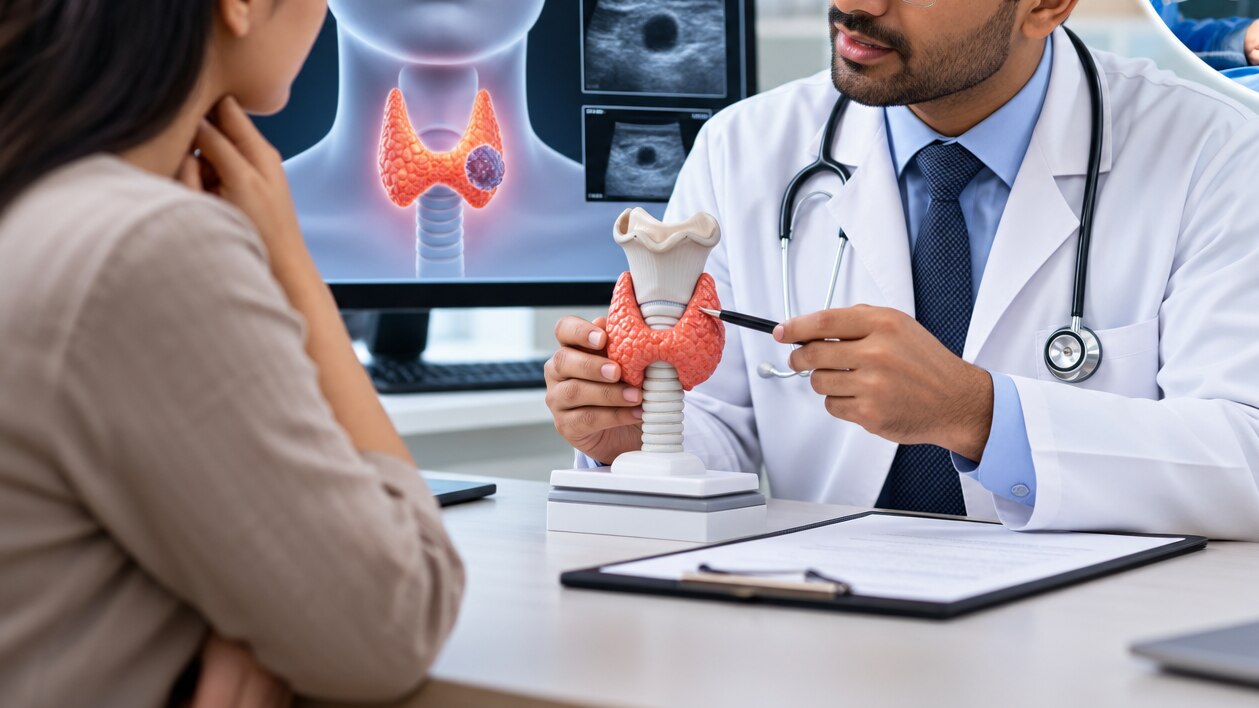
A thyroid nodule does not automatically mean cancer, and a cancer diagnosis does not automatically mean total thyroidectomy. By the end, you will understand the main thyroid cancer types, the tests used to classify them, when surveillance is reasonable, and how tumour features determine the operation and follow-up plan.
Key takeaways
- Papillary and follicular thyroid cancers spread in different ways.
- Ultrasound and fine-needle aspiration help assess suspicious thyroid nodules.
- Observation can suit selected low-risk cancers; others need surgery.
- The operation may include thyroid removal and neck lymph-node dissection.
Which thyroid cancers behave differently, and what symptoms need assessment?
The cancer type determines its likely spread, tests and operation. Papillary thyroid cancer often spreads to neck lymph nodes but remains highly treatable. Follicular thyroid cancer more often spreads through blood vessels to the lungs or bones; capsular or blood-vessel invasion confirms carcinoma, so a needle sample cannot always distinguish it from a follicular adenoma.
| Type | Behaviour | Treatment implications |
|---|---|---|
| Papillary thyroid cancer | Often lymph-node spread; many tumours are low risk | Lobectomy or total thyroidectomy depends on size, invasion and spread |
| Follicular thyroid cancer | Blood-borne spread; invasion defines malignancy | Diagnostic lobectomy may be needed when cytology is indeterminate |
| Medullary thyroid carcinoma | Starts in parafollicular C cells; may be hereditary | Check calcitonin, carcinoembryonic antigen and RET; radioactive iodine does not treat it |
| Anaplastic thyroid carcinoma | Rapid, aggressive growth with possible airway invasion | Urgent multidisciplinary care; standard thyroidectomy may not be feasible |
Ask for medical assessment if you notice:
- A thyroid nodule, enlarging neck lump or enlarged neck lymph node
- Persistent hoarseness, swallowing difficulty or breathing difficulty
- A neck mass that grows quickly, especially with noisy breathing or airway pressure
Many thyroid nodules are benign, but rapid enlargement or breathing trouble needs urgent assessment.
How doctors determine whether a thyroid nodule is cancer
Doctors move from a lump to a cancer diagnosis in stages. Thyroid-function blood tests usually include TSH and free T4. A low TSH may lead to a radionuclide scan; a “hot” nodule is rarely malignant, while normal thyroid tests do not rule cancer out.
Thyroid ultrasound shows the nodule’s size, solid or cystic structure, margins, calcifications and relationship to lymph nodes. TI-RADS converts these features into a risk category and helps set the size threshold for biopsy.
- Fine-needle aspiration cytology removes cells for laboratory examination.
- The Bethesda System reports results from Bethesda I, nondiagnostic, through Bethesda VI, malignant.
- Bethesda II usually supports observation; Bethesda V or VI usually supports surgical planning.
- Bethesda III or IV is indeterminate, so repeat sampling, molecular testing or diagnostic lobectomy may be considered.
Molecular tests look for genetic changes that raise or lower the probability of cancer in selected indeterminate nodules; they do not replace clinical judgment. Fine-needle aspiration cytology can identify papillary thyroid carcinoma, but it often cannot distinguish a follicular adenoma from follicular carcinoma.
That distinction requires finding capsular or blood-vessel invasion in the removed specimen, which is why some nodules need diagnostic lobectomy rather than immediate total thyroidectomy.
When observation is safe and when cancer needs surgery
A thyroid tumour 1 cm or smaller does not automatically require immediate surgery. Active surveillance for papillary microcarcinoma is appropriate when ultrasound shows no lymph-node or distant disease, aggressive cytology, tracheal invasion, or threatening proximity to the recurrent laryngeal nerve. Repeat ultrasound tracks growth; meaningful enlargement or a new high-risk feature triggers surgery.
Surveillance becomes unsafe when the tumour invades the trachea, oesophagus, or surrounding muscles, approaches the recurrent laryngeal nerve, or shows:
- Metastatic lymph nodes
- Distant spread to the lungs or bones
- Aggressive pathology
- Clear growth during follow-up
Thyroid cancer staging combines tumour size with local invasion, lymph-node involvement, and distant metastases. A small, intrathyroidal cancer with none of these findings has a lower recurrence risk than a tumour extending beyond the thyroid or spreading to nodes or distant organs.
Pathology adds detail after removal: margin status, extrathyroidal extension, vascular invasion, and aggressive variants refine recurrence-risk assessment. The Bethesda reporting categories guide the initial probability of malignancy; molecular testing can refine that estimate for selected indeterminate nodules, but it does not replace staging.
Surgery becomes more extensive when disease is larger, invasive, node-positive, or metastatic, and confirmed involved nodes require therapeutic neck dissection rather than observation.
Lobectomy, total thyroidectomy and neck dissection: what changes the operation?
The operation changes with tumour size, spread, pathology and the need for future radioactive iodine monitoring.
| Option | What it means | When it applies |
|---|---|---|
| Lobectomy | Removes one thyroid lobe and the isthmus; preserves the opposite lobe | A solitary intrathyroidal cancer measuring 1–4 cm without clinical nodes or distant metastases |
| Total thyroidectomy | Removes all thyroid tissue and requires lifelong levothyroxine | Tumour larger than 4 cm, gross extension beyond the thyroid, clinically involved nodes or distant metastases |
| Lobectomy for diagnosis | Removes the lobe containing an indeterminate nodule | Follicular-pattern Bethesda indeterminate nodules when cytology cannot establish invasion |
Fine-needle aspiration can identify papillary thyroid carcinoma, but it often cannot separate a follicular adenoma from follicular carcinoma. The distinction requires the specimen to show capsular or blood-vessel invasion, so diagnostic lobectomy can be safer than committing to total thyroidectomy before cancer is proven.
Lymph-node surgery is different: remove proven disease, not every possible node. A central neck dissection treats metastatic nodes beside the trachea and recurrent laryngeal nerves; a lateral neck dissection treats involved nodes along the jugular chain.
Prophylactic central-node removal is selective because it can add permanent hypoparathyroidism and recurrent-laryngeal-nerve injury without clear benefit for every small, clinically node-negative cancer.
Before surgery, confirm:
- Whether ultrasound or examination shows metastatic nodes requiring therapeutic dissection.
- Whether the tumour has gross extension or distant spread.
- Whether lobectomy leaves enough thyroid for surveillance and hormone production.
- Whether total thyroidectomy offers a specific benefit, rather than simply a larger operation.
What happens after surgery, and which risks should you weigh?
After total thyroidectomy, you need lifelong levothyroxine replacement because no thyroid tissue remains to produce hormone. Your clinician adjusts the dose with thyroid-stimulating hormone (TSH) blood tests; do not stop it when you feel well.
| Option | Hormone replacement | Follow-up and trade-off |
|---|---|---|
| Lobectomy | The remaining lobe may produce enough hormone, but some patients need levothyroxine. | Lower risk of permanent hypoparathyroidism; thyroglobulin surveillance is less straightforward. |
| Total thyroidectomy | Lifelong levothyroxine is required. | Radioactive iodine and thyroglobulin surveillance are easier, but surgical risks are higher. |
Radioactive iodine is reserved for selected differentiated cancers, not every diagnosis. Tumour size, extrathyroidal extension, lymph-node burden and distant metastases guide the decision; many low-risk cancers need neither radioactive iodine nor completion surgery.
The main complications to weigh are recurrent laryngeal nerve injury and hypoparathyroidism. Nerve injury can cause hoarseness or reduced vocal-cord movement, while hypoparathyroidism can lower calcium and cause tingling, muscle cramps or seizures. Risk rises with total thyroidectomy, reoperation, invasive tumours and extensive neck dissection.
A normal voice immediately after surgery does not rule out every nerve problem, so ask how vocal-cord function and calcium will be checked.
How cancer type and surgical approach affect specialist planning
Medullary thyroid cancer requires a different operation plan from papillary or follicular disease. Before thyroidectomy, review blood calcitonin and carcinoembryonic antigen (CEA), neck imaging, and testing for a hereditary RET mutation. A positive RET result changes family assessment and prompts pheochromocytoma screening before surgery, because an untreated adrenal tumour can make anaesthesia dangerous.
Radioactive iodine does not treat medullary cancer. In a consultation with Priyank Chawathe, the surgeon can align imaging, pathology, vocal-cord status and lymph-node findings with endocrinology and nuclear medicine input.
Anaplastic thyroid carcinoma emergency treatment focuses on the airway and the speed of disease progression. A rapidly enlarging neck mass, breathlessness, noisy breathing, swallowing difficulty or airway compromise needs urgent hospital assessment.
Surgery helps only when meaningful complete resection is feasible; otherwise coordinated airway management, radiation, systemic treatment or palliation may be safer than standard thyroidectomy alone.
| Approach | Main advantage | Main trade-off |
|---|---|---|
| Open cervical surgery | Direct access to the thyroid, central neck and lateral lymph-node compartments; familiar route for bulky or invasive disease | Visible front-of-neck scar, although it avoids the longer access path of remote techniques |
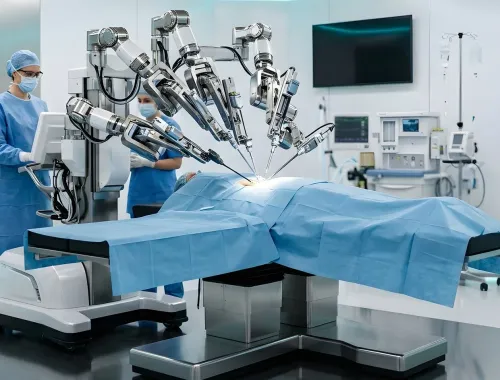
| Robotic or remote-access surgery | Places the incision in the axilla, chest or behind the ear, avoiding a front-neck scar in selected patients | Longer dissection, higher cost and approach-specific skin-flap, chest-wall or sensory injuries; it is not automatically safer or better, and does not replace proper node removal or cancer margins |
Related services
Head & Neck Oncology Head and neck oncology focuses on the diagnosis and treatment of cancers affecting the **mouth, throat, voice box, nose, sinuses, salivary glands,... View service → |
Complex Cancer Resections & Reconstructions Complex Cancer Resections & Reconstructions Some cancers can involve vital organs, major blood vessels, nerves, muscles, bones, or surrounding tissues, making their surgical treatment... View service → |
Frequently asked questions
Which thyroid cancers behave differently?
Papillary thyroid cancer often spreads to neck lymph nodes, while follicular thyroid cancer more often spreads through blood vessels to the lungs or bones. Medullary and anaplastic cancers also require different assessment and treatment planning.
How do doctors determine whether a thyroid nodule is cancer?
Doctors combine thyroid ultrasound findings, clinical assessment and fine-needle aspiration cytology. A needle sample cannot always distinguish follicular carcinoma from follicular adenoma because capsular or blood-vessel invasion must be assessed in the surgical specimen.
When is observation safe for thyroid cancer?
Active surveillance can suit selected small, low-risk papillary thyroid cancers without evidence of invasion, suspicious lymph nodes or distant spread. Surgery is needed when the tumour grows, threatens nearby structures or shows higher-risk features.
What is the difference between lobectomy, total thyroidectomy and neck dissection?
A lobectomy removes one thyroid lobe, while total thyroidectomy removes the entire gland. Neck dissection removes involved or high-risk lymph nodes and is added when cancer has spread or has a substantial risk of nodal disease.
What happens after thyroid cancer surgery?
Follow-up may include wound checks, thyroid hormone replacement after total thyroidectomy, blood tests, ultrasound and additional treatment based on the cancer type and risk. Radioactive iodine is considered for selected differentiated thyroid cancers.
Related services
Robotic & Minimally Invasive Cancer Surgery Robotic & Minimally Invasive Cancer Surgery Robotic and minimally invasive cancer surgery uses advanced surgical techniques to treat selected cancers through smaller incisions compared with... View service → |
Multidisciplinary Cancer Care & Tumor Board-Based Planning Multidisciplinary Cancer Care & Tumor Board-Based Planning Cancer treatment is most effective when every aspect of a patient’s condition is carefully evaluated and the treatment plan is tailored to their... View service → |