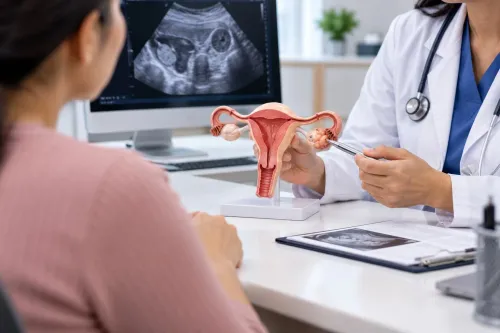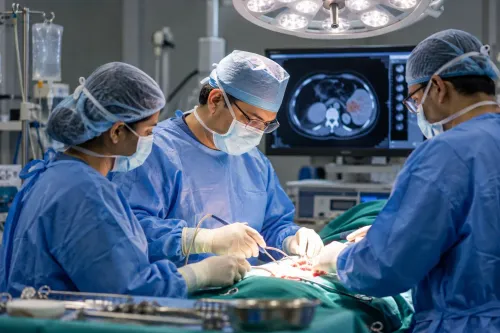

Bleeding after menopause, a sudden change in periods, or watery and blood-streaked discharge deserves attention even when the cause may be benign. You will learn which symptoms need prompt or emergency care, how doctors confirm the cause, and how surgical choices change with stage, tumour risk, fertility goals, and overall health.
Key takeaways
- Report any postmenopausal bleeding, including a single episode of spotting.
- Diagnosis usually requires an endometrial biopsy, with imaging to assess spread.
- Hysterectomy type depends on cancer stage, grade, spread, and personal priorities.
- Ask about fertility, ovarian preservation, lymph-node assessment, recovery, and alternatives.
Which bleeding patterns and other symptoms need medical attention?
Even one episode of postmenopausal bleeding needs medical assessment, whether it is spotting or a heavier flow. Bleeding between periods, a new menstrual change, unusually heavy or prolonged periods, watery or blood-tinged discharge, pelvic pain, pain during sex, or a pelvic mass also needs prompt review.
Early endometrial cancer often causes abnormal bleeding before pain or other symptoms, but symptoms alone cannot confirm or exclude cancer. Searches for heavy periods and prolonged periods cancer warning signs should lead to an examination, not self-diagnosis.
Seek evaluation sooner if you have obesity, diabetes, tamoxifen use, unopposed oestrogen exposure, polycystic ovary syndrome, Lynch syndrome, Cowden syndrome, early menarche, late menopause, or a family history of endometrial or colorectal cancer.
- Go to emergency care for bleeding that rapidly soaks pads, severe or worsening pain, dizziness, weakness, or fainting. If pregnancy is possible, mention it urgently.
Record bleeding dates, approximate pad or tampon use, relation to menopause or intercourse, discharge colour or odour, pain, medicines, tamoxifen use, and pregnancy status when relevant.
| Pattern | Possible explanations | Why review matters |
|---|---|---|
| Bleeding or watery discharge | Cancer, polyps, hyperplasia, hormonal change, infection, medication effects | Cancer and benign conditions can look alike |
| Pelvic pain or pain during sex | Fibroids, infection, mass, or other pelvic disease | Persistent or worsening symptoms need examination |
| Heavy or prolonged bleeding | Fibroids, hormonal changes, hyperplasia, or cancer | Severe bleeding can cause anaemia or require emergency care |
How is a suspected endometrial cancer diagnosed?
Diagnosis requires tissue sampling; symptoms and imaging alone cannot confirm endometrial cancer.
1. Your clinician records bleeding pattern, menopause status, medicines such as tamoxifen, pregnancy possibility, and risk factors, then performs a pelvic examination to check the vagina, cervix, uterus, and any mass.
2. A transvaginal ultrasound measures endometrial thickness and looks for a uterine mass, polyp, or irregular cavity. A thickened endometrium can raise concern, but ultrasound cannot diagnose cancer on its own.
3. An office endometrial biopsy removes a small lining sample through the cervix for laboratory examination. It is often the first tissue test, but a narrow sample can miss a focal tumour.
4. Use hysteroscopy with directed biopsy to inspect the uterine cavity and sample a visible abnormality. Dilation and curettage can obtain more tissue when the office sample is insufficient, bleeding persists, or imaging is abnormal.
Pathology may show atypical endometrial hyperplasia, a precancerous glandular abnormality, or invasive endometrial carcinoma, which has entered the supporting uterine tissue. A benign sample lowers concern but does not always explain ongoing bleeding; an insufficient sample does not rule out cancer. Persistent symptoms or abnormal imaging require repeat or more targeted evaluation.
The final report identifies histologic type, grade, depth of myometrial invasion, lymphovascular invasion, cervical involvement, and relevant molecular findings. These details predict spread risk and determine surgical staging, lymph-node assessment, and the need for chemotherapy, radiation, or other treatment.
What operation is used for endometrial cancer, and how is it selected?
For apparent stage I or II disease, the usual operation is a total hysterectomy with bilateral salpingo-oophorectomy: removal of the uterus, cervix, both fallopian tubes and both ovaries. The surgeon also assesses spread, because final findings such as myometrial invasion, lymphovascular invasion, cervical involvement, tumour type and grade determine whether chemotherapy or radiation is needed.
Sentinel lymph-node mapping identifies the first pelvic nodes draining the uterus for laboratory examination. It is not the same as removing all pelvic or para-aortic nodes. If mapping fails on one side, the team’s protocol may call for a side-specific lymphadenectomy, meaning removal of lymph nodes on that side for accurate staging.
Access choice depends on tumour size, spread, anatomy, previous operations and safety:
| Access | What it involves | When it is favoured |
|---|---|---|
| Laparoscopic | Small instruments through several small incisions | Suitable early-stage disease when safe access is possible |
| Robotic | Surgeon-controlled instruments through small incisions | Suitable minimally invasive cases; the robot does not operate independently or guarantee better cancer control |
| Open laparotomy | One larger abdominal incision | Large tumours, extensive extrauterine disease, difficult anatomy or technical and anaesthetic concerns |
Minimally invasive surgery often means less blood loss, smaller incisions and a shorter hospital stay, but it is not suitable for everyone. An open incision does not mean inferior cancer treatment.
Radical hysterectomy is not routine. It may be considered for cervical stromal involvement or selected locally advanced disease; when cancer remains in the uterine body and the cervix is uninvolved, a simple total hysterectomy is generally used.
When are fertility-sparing treatment, ovarian preservation, or more extensive surgery considered?
Fertility-sparing treatment, ovarian preservation, and more extensive surgery are exceptions to the usual hysterectomy-based plan, chosen from the tumour’s grade, spread, fertility goals, age, and genetic risk.
Removing both ovaries causes immediate surgical menopause in a premenopausal patient. Ovarian preservation is reserved for carefully selected younger patients with low-grade endometrioid cancer, no myometrial invasion or only very superficial invasion, no spread, no suspicious ovaries, and an appropriate genetic-risk review.
Fertility-sparing treatment uses progestin rather than immediate hysterectomy. It is generally limited to grade 1 endometrioid cancer confined to the endometrium.
| Option | What it involves | When it applies |
|---|---|---|
| Fertility-sparing treatment | Progestin, repeat endometrial sampling, imaging, and clinical review | Selected grade 1 endometrioid cancer without invasion or spread |
| Ovarian preservation | Hysterectomy while leaving ovaries in place | Younger, low-risk patients with reassuring ovaries and genetic assessment |
| Cytoreductive surgery | Removing all or nearly all visible tumour | Spread beyond the uterus when meaningful, safe resection appears feasible |
Fertility-sparing treatment requires close follow-up. Definitive hysterectomy is usually recommended after childbearing, or sooner if sampling shows persistence, treatment failure, or progression. High-grade, non-endometrioid, deeply invasive, or advanced cancers generally make fertility preservation and ovarian preservation unsafe.
For disease outside the uterus, cytoreductive surgery may help, but chemotherapy, radiation, hormone therapy, or another systemic treatment can be central. An open operation is not automatically inferior, and minimally invasive surgery is not automatically safer; the team should weigh cancer benefit against surgical risk and technical feasibility.
What should you ask before agreeing to endometrial cancer surgery?
Take the pathology report and imaging findings into the consultation, then ask these endometrial cancer surgery questions:
- What is the biopsy type, histologic type, and grade?
- Is there evidence of myometrial invasion, cervical involvement, lymphovascular invasion, ovarian disease, or distant spread?
- Will staging include sentinel-node mapping, pelvic lymphadenectomy, or para-aortic node assessment? What happens if mapping fails on one side?
- Why is robotic versus open surgery, or conventional laparoscopy, safest for my anatomy, tumour size, and disease extent?
- Will both ovaries and fallopian tubes be removed? What will that mean for surgical menopause, bone and cardiovascular health, fertility, and pregnancy options?
- Which findings during surgery would change the operation, such as unexpected spread, difficult anatomy, or an unsafe minimally invasive approach?
- What hospital stay, lifting limits, driving restrictions, urinary or bowel effects, and postoperative recovery should I expect?
- How will I prevent blood clots, and which bleeding, fever, wound changes, urinary problems, or abdominal symptoms require urgent review?
Robotic, laparoscopic, and open access have different trade-offs:
| Access | Typical advantages | Why it may be chosen |
|---|---|---|
| Robotic | Small incisions and controlled instrument movement | Suitable anatomy and surgeon expertise |
| Laparoscopic | Small incisions and usually shorter recovery | Appropriate early-stage disease |
| Open laparotomy | Direct access for extensive surgery | Large tumour, spread, adhesions, or safety concerns |
Robotic instruments do not operate independently and do not guarantee better cancer control. A specialist surgical oncology consultation supports endometrial cancer treatment planning when pathology, imaging, fertility goals, inherited-risk concerns, or access choice is complex; Priyank Chawathe in Mira Road East, Mira Bhayandar, is one local option for reviewing those individual findings.
Related services
Gynecologic Oncology focuses on the diagnosis and treatment of cancers affecting the female reproductive system, including cancers of the uterus, cervix, ovaries,... View service → |
Robotic & Minimally Invasive Cancer Surgery Robotic & Minimally Invasive Cancer Surgery Robotic and minimally invasive cancer surgery uses advanced surgical techniques to treat selected cancers through smaller incisions compared with... View service → |
Frequently asked questions
Which bleeding patterns need medical attention for possible endometrial cancer?
Seek medical assessment for any postmenopausal bleeding, bleeding between periods, newly heavy or prolonged periods, or other unusual menstrual changes. Watery or blood-tinged discharge, pelvic pain, pain during sex, and a pelvic mass also warrant prompt review.
How is suspected endometrial cancer diagnosed?
Evaluation can include a pelvic examination, transvaginal ultrasound, and endometrial biopsy. Hysteroscopy and dilation and curettage may be used when a biopsy is inconclusive or a focal lesion needs direct assessment. Pathology establishes the diagnosis and tumour grade; imaging helps assess spread and plan treatment.
What operation is used for endometrial cancer?
The usual operation is a hysterectomy, often with removal of both fallopian tubes and ovaries. Surgeons choose an open, laparoscopic, or robotic approach based on tumour features, anatomy, previous surgery, overall health, and the need to assess or remove lymph nodes.
When are fertility-sparing treatment or ovarian preservation considered?
Fertility-sparing treatment is considered only for carefully selected patients with low-grade, early endometrioid cancer confined to the uterus and no contraindication to pregnancy. Ovarian preservation requires separate assessment of age, ovarian function, tumour type and grade, hereditary risk, and evidence of spread. More extensive surgery is considered when cancer has spread beyond the uterus or has high-risk features.
What should you ask before agreeing to endometrial cancer surgery?
Ask for the cancer stage, grade, histology, proposed operation, reason for the surgical approach, lymph-node plan, effects on fertility and ovarian function, recovery timeline, possible complications, alternatives, and whether a second opinion or genetic assessment is appropriate.