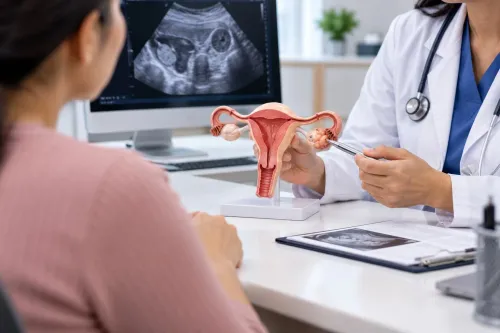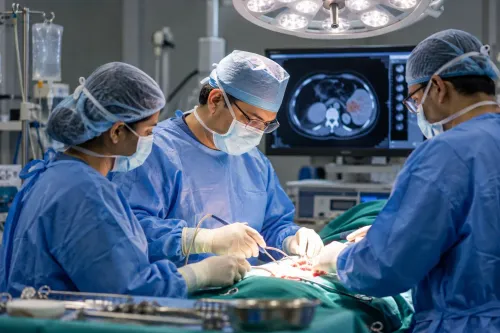

Interval cytoreduction is an operation performed after initial chemotherapy when ovarian cancer is not considered suitable for complete or safe removal at the outset. You will learn how doctors assess response and operability, what the operation is intended to achieve, and why the decision cannot be based on a CT scan or CA-125 result alone.
Key takeaways
- Interval cytoreduction follows initial chemotherapy, often after three cycles.
- Doctors assess chemotherapy response, tumour spread, and fitness before recommending surgery.
- The goal is to remove all visible tumour when safely possible.
- Ask how surgery affects recovery and the timing of postoperative chemotherapy.
What interval cytoreduction means in the treatment sequence
Interval cytoreduction, also called interval debulking surgery, is performed after initial systemic chemotherapy, most commonly after three cycles, and followed by additional chemotherapy. Neoadjuvant chemotherapy comes first to treat microscopic disease beyond visible tumours, test whether the cancer responds, reduce tumour burden, and show whether surgery is feasible.
| Approach | Timing | Purpose |
|---|---|---|
| Primary cytoreduction surgery | Before chemotherapy | Remove visible disease upfront when complete resection appears feasible |
| Interval cytoreduction | After initial chemotherapy | Reassess disease and operate when tumour reduction makes complete removal safer or achievable |
For invasive epithelial ovarian, fallopian-tube, or primary peritoneal cancer, obtain a tissue biopsy before starting neoadjuvant chemotherapy. Cytology alone may not establish the diagnosis unless obtaining tissue is unsafe.
The treatment sequence is practical:
- Imaging and biopsy establish the disease and diagnosis.
- Chemotherapy cycles begin, usually with three cycles before reassessment.
- New imaging, examination, blood counts, nutrition, treatment tolerance, and functional condition show the response.
- A multidisciplinary team reviews whether surgery is technically feasible and medically safe.
- Surgeons plan the operation, including possible treatment of peritoneal or upper-abdominal disease.
- Interval surgery is performed when its expected benefit outweighs its risks.
- Recovery is followed by postoperative chemotherapy or other planned treatment.
Chemotherapy response does not guarantee operability. The team must still determine whether all visible disease can be removed without unacceptable injury.
How doctors decide whether surgery is feasible after chemotherapy
Operability after chemotherapy depends on more than a smaller tumour on a scan. The team reassesses CT or other imaging, physical examination, blood counts, nutrition, functional condition, treatment tolerance, and the pattern of response across treatment cycles.
1. Review the disease map. Doctors look for tumour involving the bowel and mesentery, diaphragm, liver surface, stomach, spleen, bladder, ureters, major blood vessels, peritoneum, and other abdominal sites. They assess whether these areas could be removed or treated without unacceptable injury.
2. Check the CT response alongside the examination. Shrinking lesions suggest chemotherapy is working, but radiological response is not the same as operability. Smaller lesions on CT do not prove that all visible disease can be removed, and progression can indicate chemotherapy-resistant disease.
3. Consider diagnostic laparoscopy. A surgeon can inspect the abdominal surfaces directly and estimate whether complete cytoreduction is achievable before committing to a major operation. The Fagotti predictive index may score findings such as diffuse carcinomatosis, mesenteric disease, bowel or stomach involvement, and diaphragmatic disease.
4. Interpret the findings through specialist judgment. The Fagotti predictive index supports, but does not replace, an experienced assessment. The multidisciplinary team weighs disease distribution, technical resectability, expected morbidity, and your ability to recover from extensive surgery.
A recommendation for interval surgery therefore follows a combined review, not an automatic schedule after a fixed number of chemotherapy cycles. A poor nutritional or functional state, low blood counts, treatment intolerance, or disease that remains technically unresectable can change the plan.
What the operation is trying to achieve—and how extensive it may be
Successful cytoreduction means complete gross resection: removing every tumour deposit visible to the surgeon so that no macroscopic residual disease remains at the end of the operation. Residual tumour means visible cancer left behind; microscopic disease is cancer cells too small to see or remove with the naked eye and remains a separate treatment problem.
The largest ovarian mass is only one part of the operation. Implants may coat the peritoneum, diaphragm, liver surface, bowel, or other upper-abdominal structures, so the surgeon may need to treat several sites to achieve the same endpoint.
Depending on disease distribution, interval surgery can include:
- Hysterectomy and removal of both ovaries and fallopian tubes
- Omentectomy, removing the fatty tissue that commonly carries tumour deposits
- Peritoneal stripping to remove involved peritoneal surfaces
- Bowel resection, sometimes with reconstruction or a temporary stoma
- Splenectomy or surgery on the diaphragm
- Other procedures involving the stomach, liver surface, or upper abdomen
Patients with no macroscopic residual disease generally have better outcomes than patients left with visible tumour. Complete removal is not pursued at any cost: major bleeding, organ injury, loss of function, or complications that prevent further cancer treatment can make an operation unsafe.
Interval cytoreduction remains major abdominal cancer surgery, not automatically a less invasive alternative to primary surgery.
When interval cytoreduction is chosen—and when the plan changes
Chemotherapy is chosen first when disease appears too extensive for safe, complete upfront removal, or when treatment could shrink tumour and make an operation feasible. Guidelines generally favor primary debulking surgery when complete resection appears achievable with acceptable morbidity; neoadjuvant chemotherapy is favored when complete removal is unlikely or perioperative risk is high.
| Strategy | Typical rationale | What it does not guarantee |
|---|---|---|
| Primary debulking surgery | Complete resection appears feasible at the outset | A major operation will be safe or leave no visible tumour |
| Neoadjuvant chemotherapy | Disease burden or medical risk makes immediate surgery unsuitable | The cancer will respond or interval surgery will proceed |
| Interval cytoreduction | Reassessment shows surgery has become feasible after chemotherapy | Every patient will benefit from operating |
EORTC 55971 and the CHORUS trial found that, in their trial populations, neoadjuvant chemotherapy followed by interval surgery produced overall-survival and progression-free-survival results that were not inferior to primary surgery followed by chemotherapy. That does not make the approaches interchangeable: trial results do not predict the safest or most effective sequence for every patient.
The plan can change after reassessment if there is clear progression, poor functional or nutritional condition, unacceptable anaesthetic or surgical risk, or disease that still cannot be safely resected. A response on imaging is useful but does not prove operability.
No single CT finding or CA-125 value decides the case. The team weighs response over time, examination, imaging, blood counts, nutrition, fitness, and specialist multidisciplinary review before recommending surgery or continuing another treatment approach.
What to ask about surgical approach, recovery, and the next treatment step
Ask whether the team expects complete removal of all visible disease, not merely the largest ovarian mass. Include these questions in operative planning:
- Which organs might need resection, such as bowel, spleen, diaphragm, uterus, ovaries, or fallopian tubes?
- Would open cytoreductive surgery give better access for upper-abdominal, bowel, diaphragmatic, or diffuse peritoneal disease?
- Which complications could delay postoperative chemotherapy, including an anastomotic leak, infection, bleeding, prolonged bowel recovery, or poor nutrition?
- What postoperative chemotherapy is planned, and when would it restart if recovery is uncomplicated?
| Approach | What it means | When it applies |
|---|---|---|
| Robotic interval cytoreduction | Smaller incisions with robotic instruments | Carefully selected patients with limited, favorably located residual disease when the surgeon can achieve complete visible tumour removal |
| Open cytoreductive surgery | A larger abdominal incision for broad access | Extensive upper-abdominal, bowel, diaphragmatic, or diffuse peritoneal disease |
| Staged or changed plan | Surgery is delayed, modified, or not pursued | Progression, unsafe anatomy, poor fitness, or a low chance of complete cytoreduction |
Robotic equipment and small incisions do not define success. Complete visible tumour removal without unacceptable complications does; minimally invasive access is the wrong choice if it makes that endpoint less likely.
Priyank Chawathe can contribute to specialist discussion of operative feasibility, reconstruction needs, and the balance between access, safety, and complete cytoreduction. The useful question is not “Is surgery robotic?” but “Which approach gives me the best chance of complete cytoreduction after reassessment?”
Frequently asked questions
What is interval cytoreduction in ovarian cancer treatment?
Interval cytoreduction, or interval debulking surgery, is performed after initial systemic chemotherapy and followed by additional chemotherapy.
How do doctors decide whether interval cytoreduction is feasible?
They assess the cancer’s response to chemotherapy, the remaining tumour burden and spread, and whether the operation can be completed safely.
What is interval cytoreduction trying to achieve?
The operation aims to remove as much visible ovarian cancer as possible, including disease requiring extensive abdominal surgery when necessary.
When might the treatment plan change?
The plan can change when chemotherapy response is inadequate, disease remains too extensive for safe complete surgery, or your condition does not support the operation.
What should you ask before interval cytoreduction?
Ask about the surgical approach, the likely extent of the operation, recovery time, complications, and when postoperative chemotherapy will restart.