
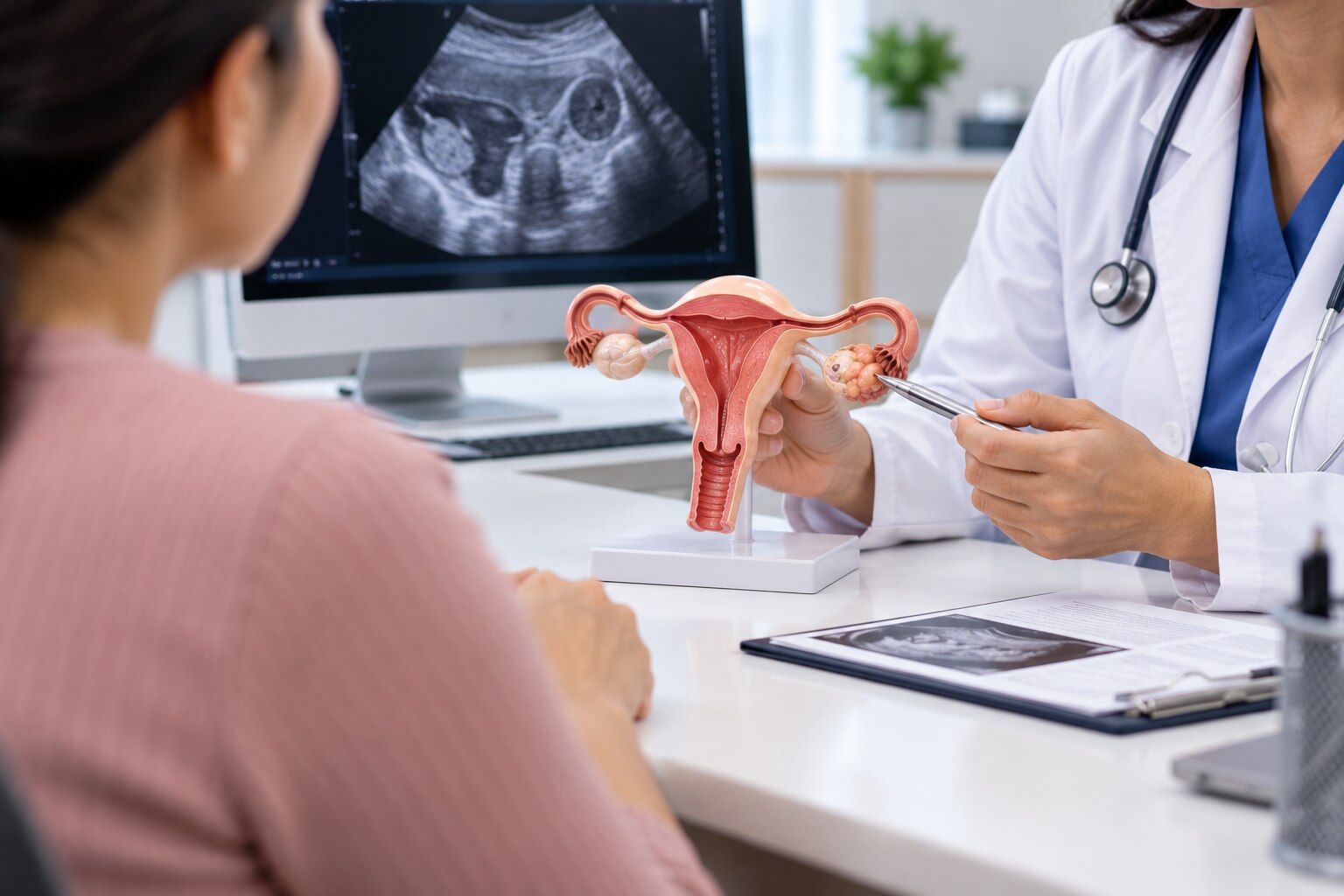
Persistent bloating, pelvic pain, early fullness or urinary changes deserve attention when they are new, frequent or unlike your usual pattern. By the end, you will know when to seek evaluation, what each test can establish, why tissue matters, and how surgeons decide between surgery first, chemotherapy first and different operative approaches.
Key takeaways
- Seek evaluation when symptoms persist for two weeks, worsen, or change your usual pattern.
- Bloating, pelvic pain, urinary changes and early fullness can warrant medical assessment.
- Scans and tumour markers guide evaluation but cannot confirm ovarian cancer alone.
- Surgery depends on stage, tumour spread, overall health and fertility goals.
Which symptoms should prompt an ovarian cancer evaluation?
Seek an ovarian cancer evaluation when symptoms last two weeks or more, worsen, or mark a clear change from your normal pattern. Do not wait for severe pain: ovarian cancer symptoms can be vague, and some people have few symptoms until disease is advanced.
| Symptom pattern | What you may notice | Why evaluation matters |
|---|---|---|
| Persistent bloating or abdominal swelling | A fuller abdomen that does not settle, or clothes becoming tighter | New, ongoing swelling deserves assessment rather than repeated treatment for indigestion |
| Pain or pressure | Pelvic pain, abdominal pain, back pain, or rectal pressure | Persistent or progressive pressure can reflect a pelvic or abdominal problem |
| Eating changes | Feeling full quickly, difficulty eating, reduced appetite, or unintentional weight change | A combination of early satiety and weight change needs prompt review |
| Bowel changes | New constipation or altered bowel habits | Constipation with pelvic pressure or swelling warrants examination |
| Urinary changes | Urinary urgency or frequency without an obvious explanation | Recurrent symptoms need review, especially with bloating or pain |
| Bleeding or low energy | Abnormal vaginal bleeding, menstrual changes, or unexplained fatigue | These findings have many causes but should not be dismissed when new or persistent |
These ovarian cancer symptoms do not diagnose cancer. Irritable bowel syndrome, urinary infection, fibroids, endometriosis, benign ovarian cysts and menstrual changes can cause the same complaints; diagnosis requires clinical assessment and, when indicated, imaging and pathological examination of cells or tissue.
There is no recommended routine screening test for average-risk women without symptoms. Transvaginal ultrasound and CA-125 screening can produce false alarms and unnecessary procedures without reducing ovarian-cancer deaths.
How can ovarian cancer symptoms be distinguished from common conditions?
Bloating, pelvic pain, bowel changes and urinary symptoms usually have noncancerous causes, but concern rises when they are new, persistent for two weeks or more, frequent, progressive, occur together or differ from your established pattern. Symptoms alone cannot diagnose ovarian cancer.
| Condition | Clues that often fit | Seek follow-up when |
|---|---|---|
| Irritable bowel syndrome | Cramping, bloating, constipation or diarrhoea that relates to bowel movements | Symptoms become persistent, progressive, or are accompanied by weight loss or urinary symptoms |
| Urinary infection | Burning, urgency, frequent urination and sometimes fever; symptoms usually improve after treatment | Symptoms return, do not clear, or occur with bloating, pelvic pain or appetite change |
| Menstrual changes | Cramping, bloating or bleeding that follows a familiar cycle pattern | Bleeding, pain or swelling is new, unusually heavy, occurs between periods or continues beyond the cycle |
| Fibroids | Heavy bleeding, pelvic pressure, constipation or urinary frequency from uterine enlargement | Pressure or bleeding worsens, or the pattern changes |
| Endometriosis | Cyclical pelvic pain, painful sex, painful bowel movements or infertility | Pain becomes non-cyclical, persistent or occurs with swelling or weight change |
| Benign ovarian cysts | One-sided pelvic pain or pressure that may settle as the cyst resolves | Pain, bloating or early fullness persists or returns |
Relief after a bowel movement does not rule out a separate problem. Antibiotics that ease a urinary infection do not replace review if urgency, pain or bloating returns. At your visit, describe timing, frequency, menstrual relationship, bowel and urinary changes, weight change and family history.
What do the examination, scans, tumour markers and biopsy actually show?
A pelvic examination can detect tenderness, fullness, or a mass, but it cannot identify its type. A transvaginal ultrasound provides close pelvic images; an abdominal ultrasound surveys through the abdominal wall. Ultrasound can classify an adnexal mass as cystic, solid, or complex, but it cannot prove malignancy.
| Test | What it adds | What it cannot do |
|---|---|---|
| CT scan | Maps disease in the abdomen, pelvis and chest | Prove cancer alone |
| MRI | Adds soft-tissue and pelvic detail | Replace pathology |
| PET-CT | Highlights metabolically active areas | Replace tissue diagnosis |
CA-125 is not cancer-specific. It can rise with:
- Endometriosis, menstruation, pelvic infection, fibroids, liver disease and other benign conditions.
A normal CA-125 does not exclude cancer. Other tumour markers have narrower uses:
- AFP, beta-hCG and LDH can support assessment of germ-cell tumours.
- Inhibin and AMH can support assessment of stromal tumours.
Definitive diagnosis requires cells or tissue examined by a pathologist. Image-guided biopsy is particularly important before chemotherapy without immediate surgery. Diagnostic laparoscopy can inspect disease and obtain washings or biopsies; when immediate removal and staging are appropriate, tissue is obtained during surgery.
Histology changes treatment:
- Epithelial ovarian, fallopian-tube and primary peritoneal cancers are related but distinct diagnoses.
- Germ-cell tumours follow different treatment pathways.
- Stromal tumours require another treatment approach.
A scan suggests; tissue decides.
What does staging reveal, and when is ovarian cancer surgery used?
FIGO staging shows whether cancer is confined to an ovary or pelvis or has spread across the peritoneum, omentum, lymph nodes, diaphragm, liver surface, bowel or distant organs. Some teams and laboratories also report TNM terminology.
CT, MRI and other imaging suggest the disease’s distribution, but surgery often provides more complete staging. Surgeons inspect the abdomen and pelvis, collect abdominal washings, biopsy suspicious peritoneal areas and send removed tissue for pathology. These findings establish the tumour type, stage and treatment plan.
Surgery can be diagnostic and therapeutic at the same time. Depending on tumour type, fertility goals and disease distribution, it may remove both ovaries and fallopian tubes, the uterus, omentum, visible peritoneal disease and affected lymph nodes.
In advanced epithelial cancer, cytoreduction or debulking surgery aims for no visible residual disease when that can be achieved safely—not simply removal of the largest ovarian mass.
| Treatment pathway | What it involves | When it applies |
|---|---|---|
| Primary debulking surgery | Surgery followed by platinum-based chemotherapy | Patient is fit and imaging suggests complete or near-complete removal is feasible |
| Chemotherapy first | Biopsy-confirmed treatment, then interval debulking surgery | Disease is too extensive for safe complete initial removal, or immediate major surgery is unsuitable |
Diagnostic laparoscopy can test resectability before a major operation. It helps the team avoid an operation unlikely to achieve useful clearance. A specialist such as Priyank Chawathe can help coordinate this assessment when imaging, fitness and surgical goals need joint review.
Related services
Gynecologic Oncology focuses on the diagnosis and treatment of cancers affecting the female reproductive system, including cancers of the uterus, cervix, ovaries,... View service → |
Peritoneal Surface Malignancies Peritoneal Surface Malignancies Peritoneal Surface Malignancies are cancers that develop in or spread to the peritoneum, the thin lining that covers the abdominal organs and the... View service → |
How should you weigh open, minimally invasive, robotic and fertility-sparing surgery?
Choose the operation that achieves complete staging and cancer clearance, not simply the smallest incision.
| Option | Main advantage | Key limitation |
|---|---|---|
| Open surgery | Broad access for extensive disease | Larger incision and longer recovery |
| Minimally invasive surgery | Smaller incisions and faster recovery | Inadequate if disease requires wide exposure |
| Robotic surgery | Precise instrument control through small incisions | Not suitable when disease cannot be safely reached or removed |
| Fertility-sparing surgery | Preserves the uterus and opposite ovary | Suitable only for selected early, favourable tumours |
Robotic surgery or other minimally invasive surgery can suit selected apparently early-stage cancers and carefully chosen interval procedures after chemotherapy. The surgeon must still obtain washings, biopsies and required staging, while removing all visible disease that can be safely cleared.
Diffuse peritoneal deposits or extensive disease near the diaphragm, liver surface, stomach or bowel often requires open surgery. Conversion from minimally invasive surgery is appropriate when bleeding control, visualisation, safe dissection or complete removal demands it. Avoiding conversion is not more important than leaving no removable tumour behind.
Fertility-sparing surgery requires discussion of the opposite ovary, uterus, staging adequacy and recurrence risk. It is not appropriate for most advanced cancers.
Ask a gynecologic oncologist:
- What residual disease do you expect after surgery?
- Could bowel, diaphragm or other upper-abdominal procedures be needed?
- What complications and recovery time are realistic?
- Should genetic evaluation change the plan?
- How will surgery coordinate with platinum-based chemotherapy?
- How many operations like this do you perform each year?
Frequently asked questions
Which symptoms should prompt an ovarian cancer evaluation?
Arrange an evaluation when bloating, pelvic or abdominal pain, feeling full quickly, urinary changes, constipation, fatigue, or abnormal bleeding lasts two weeks, worsens, or clearly differs from your usual pattern.
How can ovarian cancer symptoms be distinguished from common conditions?
Symptoms alone cannot reliably distinguish ovarian cancer from indigestion, irritable bowel syndrome, urinary problems, fibroids, endometriosis, or menopause-related changes. Persistence, progression, several symptoms together, or a clear change from your normal pattern warrants assessment.
What do examination, scans, tumour markers and biopsy show?
A pelvic examination checks for masses or tenderness. Ultrasound and CT or MRI show the size, location and spread of an abnormality. CA-125 and other tumour markers support assessment but do not diagnose cancer alone. A biopsy examines tissue and confirms the diagnosis.
When is ovarian cancer surgery used, and how do options differ?
Surgery can remove the tumour, affected ovary, both ovaries, the uterus, fallopian tubes, visible disease and selected lymph nodes for staging or treatment. Open surgery offers wider access, while minimally invasive or robotic surgery uses smaller incisions in carefully selected cases. Fertility-sparing surgery is considered only when cancer type and stage make it safe.
Related services
Robotic & Minimally Invasive Cancer Surgery Robotic & Minimally Invasive Cancer Surgery Robotic and minimally invasive cancer surgery uses advanced surgical techniques to treat selected cancers through smaller incisions compared with... View service → |
Complex Cancer Resections & Reconstructions Complex Cancer Resections & Reconstructions Some cancers can involve vital organs, major blood vessels, nerves, muscles, bones, or surrounding tissues, making their surgical treatment... View service → |