
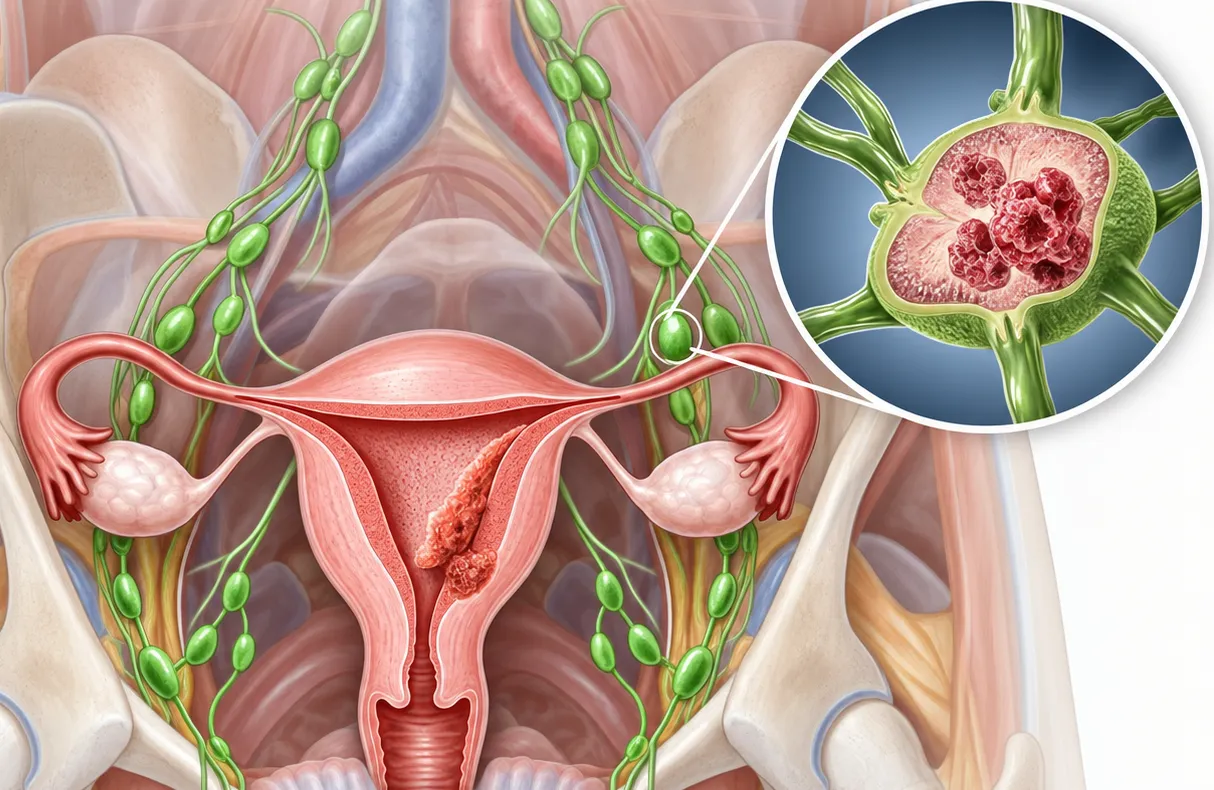
When endometrial cancer is diagnosed, one important question is whether malignant cells have moved beyond the uterus. Lymph node biopsy in endometrial cancer can provide valuable staging information in selected patients and may influence decisions about treatment after surgery.
For women undergoing assessment in Dahisar, understanding the purpose of lymph-node evaluation can make discussions about cancer surgery less confusing.
Why are lymph nodes important?
Lymph nodes form part of the body's lymphatic system. Cancer cells from certain tumours can travel through lymphatic channels and reach nearby nodes.
Finding cancer cells in lymph nodes can change the stage of disease and may affect recommendations for postoperative treatment.
However, not every patient necessarily requires the same extent of lymph-node surgery.
How do doctors decide whether nodes need assessment?
Several tumour-related factors can influence the decision.
Doctors may consider:
- Histological type
- Tumour grade
- Depth of invasion
- Imaging findings
- Estimated stage
- Tumour size
- Other pathological risk factors
- Patient-specific surgical considerations
The strategy should therefore be individualized.
Sentinel lymph-node assessment
In selected patients, sentinel lymph-node mapping may be considered.
A sentinel node is among the first lymph nodes to which cancer cells are likely to spread from the primary tumour. Identifying and examining these nodes can provide staging information while potentially limiting the extent of lymph-node removal in appropriate cases.
Whether this technique is suitable depends on the clinical setting, available expertise, and individual treatment plan.
Is lymph-node assessment the same as removing many nodes?
Not necessarily.
Different approaches may be used depending on the patient's cancer characteristics.
Some patients may undergo sentinel-node evaluation. Others may require a different nodal assessment strategy. In certain lower-risk situations, extensive nodal surgery may not be necessary.
This is why patients should ask what is being recommended specifically in their case rather than assuming all endometrial cancer operations are identical.
What are the possible considerations?
Any surgical procedure has potential risks.
With lymph-node surgery, relevant considerations can include bleeding, infection, injury to nearby structures, lymphatic fluid collections, or swelling related to lymphatic disruption.
The likelihood and importance of these risks depend partly on the extent of surgery and the individual patient.
The potential staging benefit therefore needs to be balanced against surgical considerations.
How can lymph-node results affect treatment?
If lymph nodes are found to contain cancer cells, the oncology team may recommend additional treatment based on the complete pathology and stage.
Even when nodes are negative, other tumour characteristics may influence postoperative recommendations.
Lymph-node findings are therefore one component of the final pathology assessment rather than the only factor determining further care.
Dr. Priyank Chawathe provides surgical oncology evaluation for patients with endometrial and other gynaecological cancers, including discussion of staging procedures when clinically indicated.
Questions to ask before surgery
Patients can ask whether lymph-node assessment is recommended, what technique is planned, what information it may provide, and how the results could change further treatment.
It is also reasonable to ask about possible complications and whether minimally invasive surgery is appropriate.
Lymph-node evaluation is fundamentally a staging tool. Its purpose is to obtain information that helps clinicians understand the extent of cancer and plan subsequent care more accurately.
The most appropriate strategy depends on the individual cancer rather than a single routine approach for every endometrial cancer patient.
Keywords